
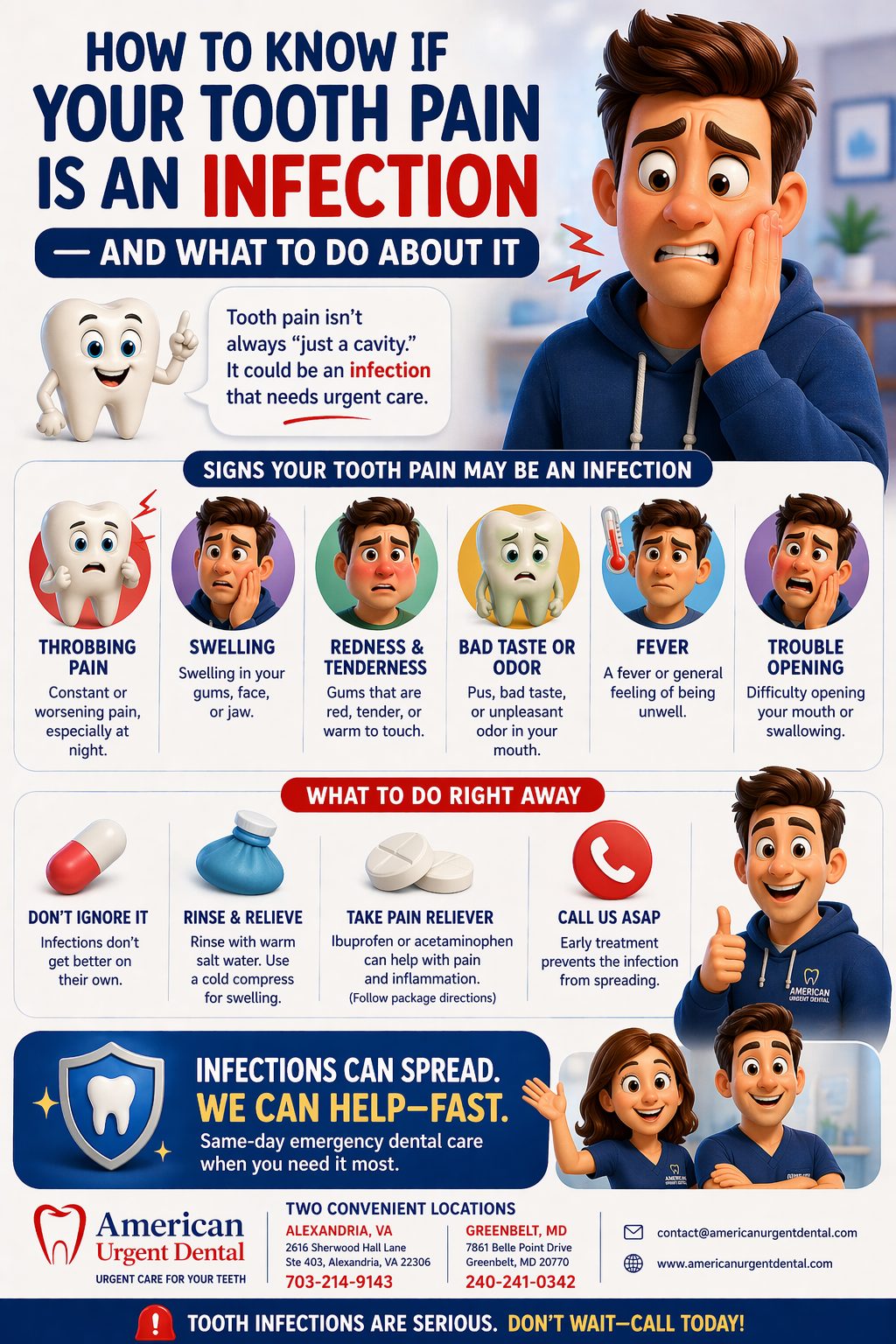
How to Know If Your Tooth Pain Is an Infection — And What to Do About It
Not all tooth pain means infection — but some does, and missing the signs can be dangerous. Learn to tell the difference and get same-day care in Alexandria, VA or Greenbelt, MD.
Pain Doesn't Always Mean Infection — But Sometimes It Does
One of the most important distinctions in dental emergency care is understanding when tooth pain signals a simple structural problem versus when it signals an active bacterial infection. These two situations have very different urgency levels, different treatment approaches, and very different consequences if left untreated. Knowing how to read your own symptoms could be the difference between a routine dental visit and a hospital admission.
At American Urgent Dental, we treat dental infections every day at our Alexandria, VA and Greenbelt, MD locations. Many patients arrive having waited far longer than they should have, either because they didn't recognize the infection signs or because they hoped the pain would resolve on its own. This guide helps you recognize an infected tooth early — before it becomes a dangerous emergency.
What Causes a Dental Infection?
A dental infection occurs when bacteria invade the inner tissues of the tooth or the surrounding gum and bone. The most common pathways for this invasion include:
- Tooth decay: A cavity that progresses deep enough to breach the enamel and dentin, reaching the inner pulp chamber where nerves and blood vessels reside. Once bacteria colonize the pulp, infection is inevitable without treatment.
- Cracked or fractured tooth: A crack in the tooth provides a direct pathway for bacteria to bypass the protective enamel and enter the pulp. Cracks from grinding, biting hard foods, or trauma are common culprits.
- Gum disease: Advanced periodontitis creates deep pockets between the gums and teeth where bacteria thrive and can eventually invade the bone and root surface.
- Failed dental work: Old fillings, crowns, or root canals that have developed leaks or secondary decay can allow bacteria to reenter a previously treated tooth.
- Trauma: A blow to the tooth that kills the pulp (even without an immediate crack) allows bacteria to colonize the dead tissue over time.
Infection vs. Non-Infection Pain: Key Differences
Signs Your Pain Is Likely NOT a Current Active Infection
- Brief, sharp sensitivity to cold that resolves within 1–2 seconds — often just exposed dentin or early-stage reversible pulpitis
- Mild aching after eating hard foods that resolves within an hour
- Soreness from a new filling or recent crown (expected for 1–2 weeks)
- Sensitivity to biting in a specific spot without any other symptoms — may be a high bite or minor fracture
- Generalized sensitivity to cold across multiple teeth — often from gum recession or dentin hypersensitivity
Signs Your Pain IS Likely an Active Infection
- Spontaneous, throbbing pain that occurs without any stimulus — you're in pain without touching, eating, or drinking anything
- Pulsing pain that follows your heartbeat — this is a classic sign of an abscess under pressure
- Fever — any temperature above 99°F alongside tooth pain is a red flag for spreading infection
- Swelling in your face, jaw, cheek, or lymph nodes under the jaw or neck
- Bad taste or smell that you can't attribute to food — often means pus is present and draining
- A bump or pimple on the gum near the painful tooth — a dental fistula indicating the abscess is seeking a drainage path
- Extreme sensitivity to heat, especially pain that is relieved by cold — a classic late-stage sign of a dying infected pulp
- Extreme pain when biting even very gently on a specific tooth — indicates periapical pressure from an abscess
- Tooth feels 'longer' than usual — the tooth may have been slightly elevated by abscess pressure
⚠️ Warning: If you have fever, facial swelling, difficulty swallowing, or difficulty breathing alongside dental pain — call 911 or go to the nearest emergency room immediately. These signs indicate a potentially life-threatening spreading infection.
The Progression of Dental Infection: Why Timing Matters
Dental infections don't stay put. They follow a predictable escalation pattern that makes timing of treatment critically important:
- Pulpitis stage: Bacteria have reached the pulp but haven't yet killed it. The tooth is painful, sensitive, and the infection is contained within the tooth. This is the easiest and cheapest stage to treat — a root canal or filling (in early reversible cases) is all that's needed.
- Pulp necrosis stage: The pulp has died. The pain from pulpitis may temporarily subside, leading patients to believe the problem has resolved. It has not. Bacteria continue multiplying in the dead pulp tissue and begin moving through the root tips.
- Periapical abscess stage: A pocket of infection forms at the root tip in the surrounding bone. Pain returns — often severe throbbing pressure pain. The infection is now outside the tooth and in the bone.
- Spreading cellulitis stage: The infection spreads into the surrounding soft tissue. Facial swelling becomes visible. The infection is now diffuse and harder to treat.
- Systemic spread: In the most severe cases, bacteria enter the bloodstream (sepsis) or spread to the neck or brain spaces (Ludwig's angina, cavernous sinus thrombosis). These are life-threatening medical emergencies.
The gap between stages one and five can be as short as days to weeks in some patients — particularly those who are diabetic, immunocompromised, or older. This is not a situation where 'waiting to see' is safe.
Home Management While You Wait for Care
These strategies help manage symptoms but do not treat the infection. They are appropriate while you arrange an appointment — not as a substitute for dental care:
- Ibuprofen (anti-inflammatory): The most effective OTC option for dental infection pain because it targets both pain AND the inflammatory component of the abscess pressure. Take 400–600mg every 6 hours if appropriate for you.
- Salt water rinse: Warm salt water (1/2 teaspoon in 8oz) rinsed gently reduces surface bacteria and provides mild comfort. Do not swish vigorously — it won't drain the abscess.
- Cold compress to outside of cheek: Helps reduce swelling and numbs the area. 15 minutes on, 15 minutes off. Never apply heat — it can accelerate bacterial spread.
- Sleep with head elevated: Lying flat increases blood pressure in the head, which intensifies throbbing abscess pain. Extra pillows help significantly.
- Avoid the trigger side: Don't eat or drink on the affected side. Avoid temperature extremes.
✅ Tip: Do NOT attempt to pop or drain an abscess yourself. This can push bacteria deeper into surrounding tissue and dramatically worsen the infection's spread.
What Treatment Looks Like at American Urgent Dental
When you arrive at American Urgent Dental with symptoms of a dental infection, here is what you can expect:
- Digital X-rays to identify the exact source and extent of the infection, including bone involvement
- Clinical examination including percussion testing (tapping the tooth), thermal testing, and periodontal probing
- Clear diagnosis and honest explanation of findings — you'll understand exactly what's happening before treatment begins
- Same-day treatment whenever possible: root canal therapy (to remove the infected pulp while saving the tooth), incision and drainage of accessible abscesses, or extraction if the tooth is not restorable
- Antibiotic prescription when infection shows signs of spreading beyond the immediate area
- Pain management guidance and follow-up scheduling to ensure the infection resolves completely
We see infected teeth every single day. We know how much pain you're in and we know how to help — quickly, gently, and effectively. Please call us rather than suffering through it: Alexandria at 703-214-9143 (alexandria@americanurgentdental.com) or Greenbelt at 240-241-0342 (greenbelt@americanurgentdental.com).
Get Same-Day Emergency Dental Care
American Urgent Dental — two convenient locations serving Northern Virginia and the Greater DC Metro area.
Alexandria, VA: 2616 Sherwood Hall Lane Ste 403, Alexandria, VA 22306 | 703-214-9143 (alexandria@americanurgentdental.com)
Greenbelt, MD: 7861 Belle Point Drive, Greenbelt, MD 20770 | 240-241-0342 (greenbelt@americanurgentdental.com)
📧 contact@americanurgentdental.com | 🌐 www.americanurgentdental.com
Don’t wait out the pain.
Same-day emergency care in Alexandria, VA & Greenbelt, MD — open weekends.