
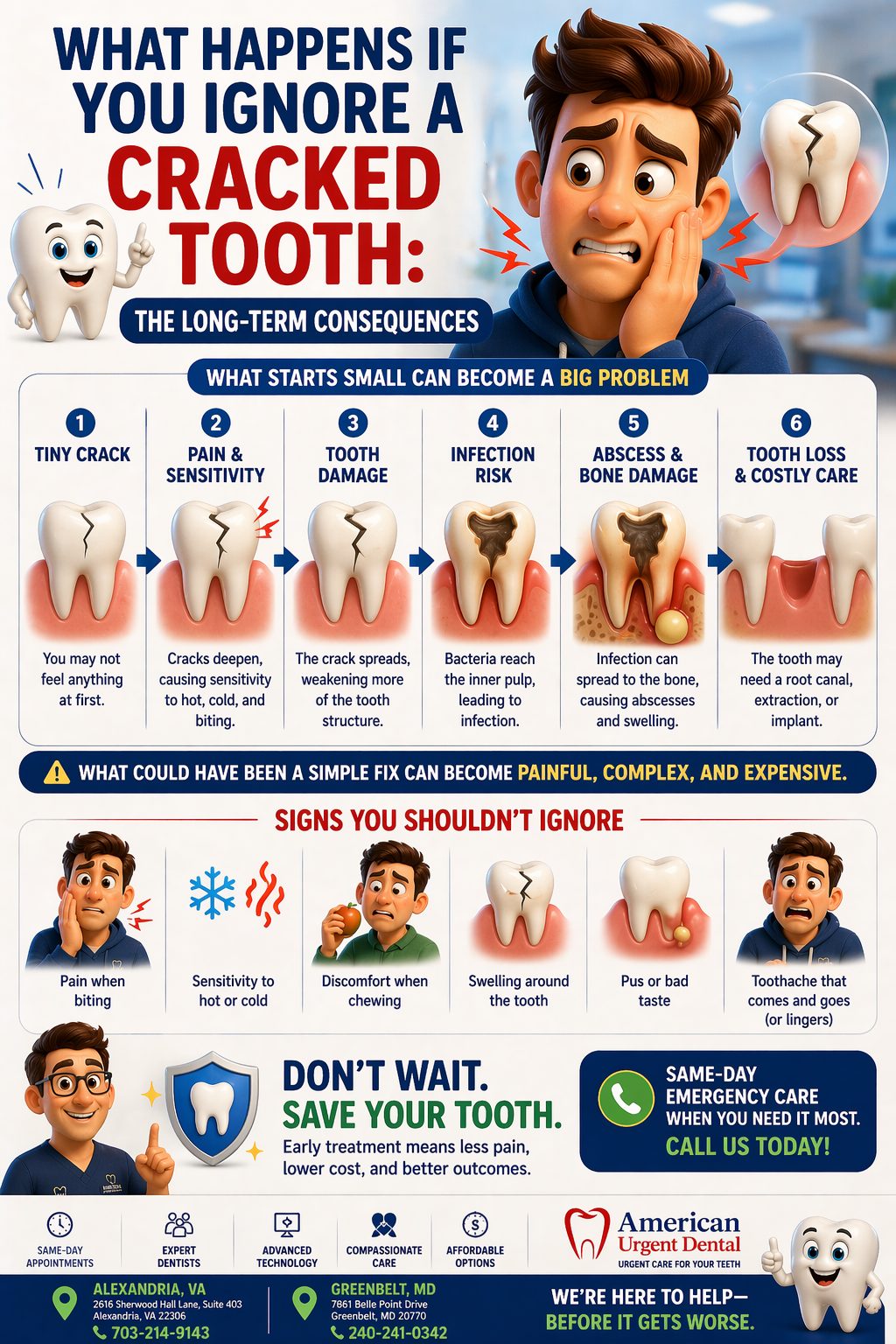
What Happens If You Ignore a Cracked Tooth: The Long-Term Consequences
A cracked tooth that seems minor today can become a dental catastrophe. Learn what happens when cracks go untreated and how American Urgent Dental in Alexandria, VA and Greenbelt, MD can help.
The Crack You're Ignoring Could Cost You the Tooth
It started with a brief sharp pain when you bit down on something hard. Or maybe you noticed a subtle sensitivity on one side. You told yourself it wasn't that bad and moved on. Days later, it's still there — same brief jab, maybe slightly more often. You're managing. You can eat on the other side. You'll deal with it eventually.
This is one of the most common — and most costly — patterns we see at American Urgent Dental. Cracked teeth that are ignored in their early stages almost always become significantly more serious problems over time. Understanding exactly what happens inside a cracked tooth when it's left untreated can help you understand why the best time to act is always right now.
How a Tooth Crack Progresses Over Time
Week 1–4: The 'Manageable' Phase
In the early stages of a crack, the symptoms are intermittent and relatively tolerable. You feel a sharp jolt of pain when biting down — specifically when the bite releases, not when it lands. This is the classic cracked tooth syndrome pattern. Between these brief pain episodes, you feel fine. The tooth looks normal. You might convince yourself it's getting better.
What's actually happening inside the tooth: every time you bite down, the two sides of the crack flex slightly apart, then snap back together when you release. This repeated mechanical stress is like bending a paper clip back and forth — each flex moves the crack a tiny fraction deeper into the tooth structure. Meanwhile, bacteria in your mouth are exploring that crack and beginning to penetrate the dentin tubules exposed along the fracture line.
Month 1–3: Deepening Symptoms
The crack has now propagated deeper. You're noticing the pain is slightly more frequent and slightly more intense. Temperature sensitivity has appeared — the cold water you drink is now triggering a zing on that side. You're getting better at avoiding that side of your mouth, but the compensation is affecting how you chew.
Inside the tooth: the crack is approaching the pulp (nerve). Bacteria have made significant progress down the fracture line. Inflammation in the pulp is beginning. The pulp is trying to defend itself, depositing tertiary dentin to block the advancing crack — but this repair process has limits.
Month 3–6: The Pulp Becomes Involved
The crack has reached or is very near the pulp. Spontaneous pain episodes begin — pain without any biting or temperature trigger. You might wake up at night with a throbbing ache. Cold is intensely sensitive. You start taking ibuprofen regularly. The tooth has progressed from cracked tooth syndrome to pulpitis — the nerve is now actively inflamed and beginning to die.
At this stage, a root canal is now almost certainly needed — whereas earlier treatment might have only required a crown. The crack may also have propagated below the gumline, which significantly complicates treatment.
Beyond 6 Months: Irreversible Damage
Several possible outcomes, none of them good:
- Vertical root fracture: The crack has propagated down the root. A vertical root fracture almost always means extraction — there is no restorative option for a split root.
- Dental abscess: The dead or dying pulp has become infected. Significant pain, possible swelling, fever. Root canal or extraction required immediately.
- Complete tooth split: The tooth breaks in two under normal chewing forces. What was once a treatable crack is now a broken tooth often requiring extraction.
- Bone loss: Chronic infection around a cracked tooth destroys surrounding bone over months, making implant placement more complex and expensive later.
Why 'Watching It' Doesn't Work for Cracks
Unlike many medical conditions where watchful waiting is a legitimate strategy, cracked teeth don't 'stabilize' on their own. Here's why: every bite you take — every single meal, every sip of a chewy food — applies forces to that crack. The chewing forces generated by the average adult can exceed 200 pounds per square inch on molars. There is no way to bite gently enough to prevent crack propagation once a significant crack is present.
The only way to stop a crack from progressing is to physically protect it with a dental crown — a cap that holds the tooth together and prevents the flexing motion that advances the fracture. The longer you wait for that crown, the deeper the crack grows, and the more likely the tooth will need root canal treatment (or worse) before the crown can be placed.
Cracked Tooth Cost Comparison: Acting Now vs. Waiting
- Crack treated immediately with a crown: $1,000–$2,000 for crown fabrication. Tooth saved. No further treatment needed for years.
- Crack treated after pulp involvement: $900–$1,500 root canal + $1,000–$2,000 crown = $2,000–$3,500. Tooth saved, but more work required.
- Crack treated after vertical root fracture: $150–$600 extraction + 3–6 months healing + $3,000–$6,000 dental implant = $3,500–$7,000. Tooth lost.
- Crack untreated until abscess and bone loss: Emergency extraction + possible bone grafting + implant = $5,000–$9,000 or more.
How We Diagnose and Treat Cracked Teeth at American Urgent Dental
Diagnosing cracked teeth requires specialized techniques because cracks are often invisible on routine X-rays. At American Urgent Dental, we use:
- Bite test (tooth sleuth or Burlew disk): Asking you to bite on a small instrument one cusp at a time to localize the crack precisely
- Transillumination: Shining a fiber-optic light through the tooth — cracks interrupt the light path and appear as dark lines
- Staining: Dyes that penetrate and highlight crack lines invisible to the naked eye
- Digital X-rays: While cracks themselves may not show, periapical changes from chronic infection adjacent to a crack are visible
- Clinical assessment: Evaluating the extent of the crack relative to the gumline, which determines whether the tooth is restorable
Treatment is then tailored to the crack's depth and extent — from a simple crown for a contained coronal crack to root canal plus crown for pulp involvement, with extraction reserved for cracks that have progressed below the bone level.
If you have a tooth that hurts briefly when you bite and then releases — please call us today. That's the sound of a crack that can still be saved. Alexandria: 703-214-9143 (alexandria@americanurgentdental.com) | Greenbelt: 240-241-0342 (greenbelt@americanurgentdental.com).
Get Same-Day Emergency Dental Care
American Urgent Dental — two convenient locations serving Northern Virginia and the Greater DC Metro area.
Alexandria, VA: 2616 Sherwood Hall Lane Ste 403, Alexandria, VA 22306 | 703-214-9143 (alexandria@americanurgentdental.com)
Greenbelt, MD: 7861 Belle Point Drive, Greenbelt, MD 20770 | 240-241-0342 (greenbelt@americanurgentdental.com)
📧 contact@americanurgentdental.com | 🌐 www.americanurgentdental.com
Don’t wait out the pain.
Same-day emergency care in Alexandria, VA & Greenbelt, MD — open weekends.