
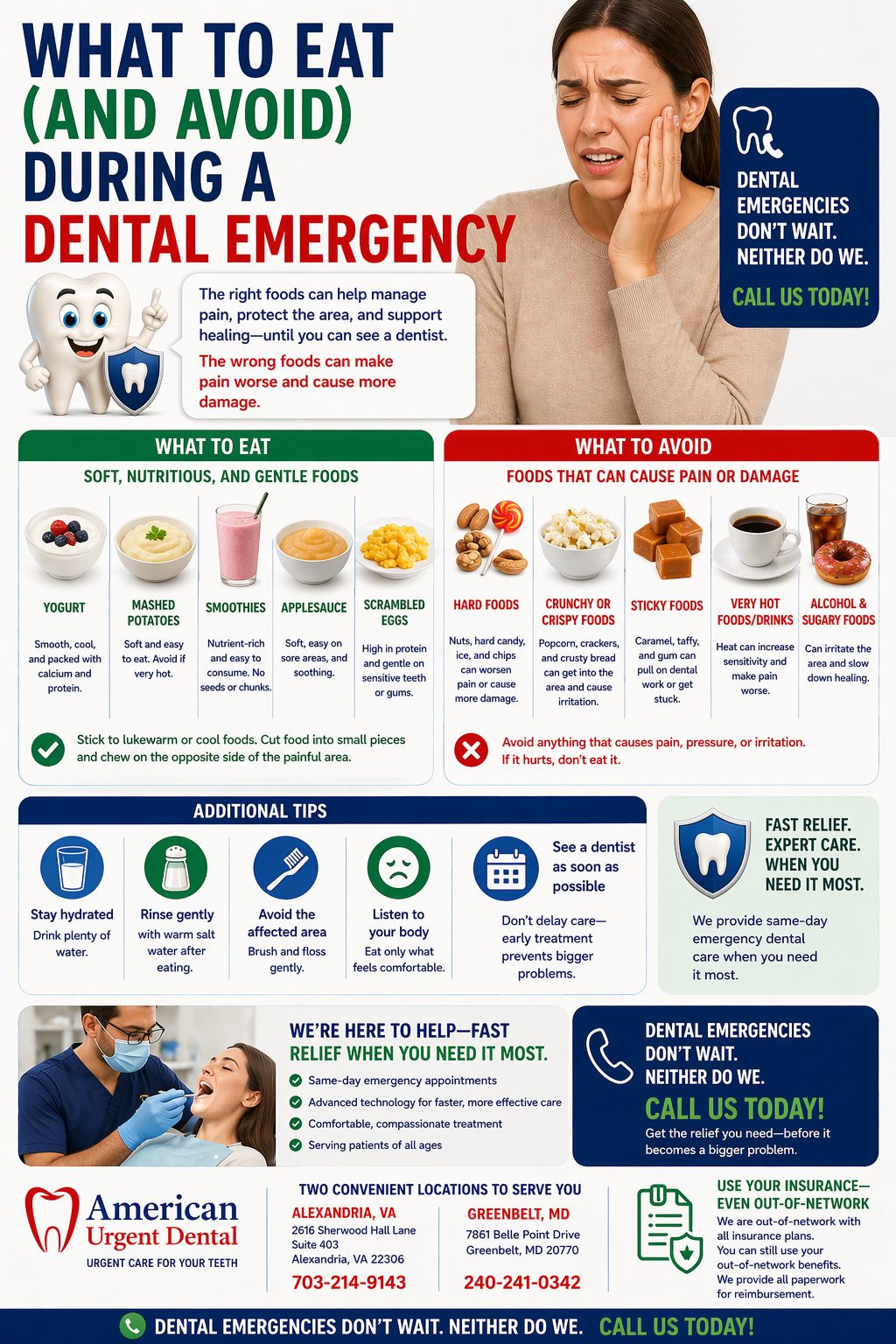
What to Eat (and Avoid) During a Dental Emergency
What you eat during a dental emergency can help or hurt your recovery. American Urgent Dental in Alexandria, VA and Greenbelt, MD explains the best and worst foods for dental emergency situations.
Eating With a Dental Emergency: It Matters More Than You Think
When you're experiencing a dental emergency, eating might be the last thing on your mind — or it might be a pressing concern if you're in the middle of a workday, caring for children, or haven't eaten in hours. Understanding what is safe to eat (and what can make things significantly worse) during a dental emergency is genuinely useful, practical knowledge.
This guide covers dietary guidance for the most common dental emergency scenarios — before treatment, and during recovery after same-day emergency treatment at American Urgent Dental.
General Principles for Eating During Any Dental Emergency
Before diving into specific scenarios, these principles apply broadly to almost all dental emergencies:
- Avoid the affected side entirely: Any dental emergency involves a vulnerable area. Chewing on that side — with an abscess, a cracked tooth, a lost crown, a recently extracted socket — can worsen pain, advance a crack, dislodge a clot, or displace a temporary restoration.
- Avoid temperature extremes: Hot and cold foods and beverages are powerful triggers for almost all dental pain conditions involving exposed dentin, pulpitis, or fractured teeth. Lukewarm or room-temperature foods are safest.
- Avoid hard and crunchy foods: Crackers, raw vegetables, nuts, hard bread, chips — these require significant bite force and can fracture a compromised tooth, dislodge a temporary filling, or cause acute pain.
- Avoid sticky foods: Caramel, taffy, chewing gum, dried fruit, and sticky candy can pull out temporary fillings, dislodge loose crowns, and are difficult to remove from around vulnerable tooth areas.
- Avoid sweet and acidic foods: Exposed dentin is highly sensitive to sugar and acid. These triggers can cause significant pain around a lost filling, cracked tooth, or area of active infection.
Best Foods During a Dental Emergency: The Safe List
These foods are generally safe for people experiencing dental emergencies:
- Scrambled eggs: Soft, room temperature, nutritionally complete, require minimal chewing. An ideal emergency meal.
- Yogurt (plain, unsweetened): Cold can be an issue if dentin is exposed — let it warm to room temperature. High in protein and calcium.
- Soup (broth-based, lukewarm, strained): Clear broths and strained soups provide nutrition with minimal chewing requirements. Important: let it cool to lukewarm — hot liquid is a significant pain trigger during dental emergencies.
- Mashed potatoes: Soft, filling, temperature-controllable. A reliable dental emergency staple.
- Banana: Soft, naturally sweet but low acid. Easy to eat with minimal chewing.
- Applesauce (unsweetened): Smooth consistency, requires no chewing. Good for post-extraction and post-procedure recovery.
- Oatmeal (cooked until very soft, allowed to cool): Warm but not hot, soft enough to eat without significant chewing.
- Avocado: Soft, nutritious, requires minimal chewing.
- Tofu (soft): High protein, very soft texture.
- Soft-cooked fish: Flaky, protein-rich, soft when cooked well. Salmon baked until very tender is ideal.
- Smoothies (through a cup, not a straw): Nutritionally complete, no chewing required. Important exception: if you've had a recent tooth extraction, do NOT use a straw — the suction can dislodge the blood clot and cause dry socket.
Specific Dietary Guidelines by Emergency Type
Active Dental Abscess
With an active abscess, the affected tooth is acutely sensitive to pressure and temperature. Eat only on the unaffected side. Avoid all hot foods and beverages — heat increases blood flow to the area and intensifies throbbing pain. Warm salt water rinses (not hot) are beneficial between meals.
After Tooth Extraction (First 24 Hours)
This is the most restrictive dietary period. Stick to:
- Room-temperature soft foods only
- No straws, no spitting, no vigorous rinsing
- No hot foods or beverages (heat disrupts clot formation)
- No hard, crunchy, or small-particle foods (rice, seeds, nuts can pack into the socket)
- Smoothies and shakes can be consumed but drink from the cup, not through a straw
After Tooth Extraction (Days 2–7)
Gradually advance as comfort allows, still avoiding the extraction side. By day 5–7 most patients can eat near-normal soft foods. Full chewing on the extraction site should wait until the socket is well healed — typically 2 weeks.
Cracked Tooth Awaiting Treatment
The crack propagates with bite force. Eat only on the unaffected side. Avoid all hard, crunchy, and sticky foods until the tooth is protected with a crown. Avoid temperature extremes.
Lost Crown or Filling (With Temporary Cement)
Temporary dental cement is not as strong as permanent cement. Avoid sticky foods entirely (they pull out temporary restorations most efficiently). Avoid hard foods. Eat on the other side as much as possible.
Hydration During a Dental Emergency
Staying well-hydrated supports healing and helps manage pain. Drink room-temperature water freely. Avoid: hot tea and coffee (temperature trigger), sodas and juice (acid and sugar sensitivity), alcohol (impairs healing, interacts with pain medication and antibiotics, dries the mouth).
Nutrition Matters for Dental Healing
For patients recovering from emergency dental treatment — particularly extractions, root canals, and abscess drainage — adequate nutrition supports healing:
- Protein: Essential for tissue repair. Eggs, yogurt, soft fish, tofu are excellent sources that don't require hard chewing.
- Vitamin C: Critical for collagen synthesis in healing tissue. Soft fruits, fortified smoothies.
- Zinc: Supports immune function and wound healing. Available in soft-cooked meats and legumes.
- Vitamin D and calcium: Support bone healing after extractions. Dairy (yogurt, milk), fortified products.
We know that a dental emergency disrupts your life — including your ability to eat normally. These dietary adjustments are temporary. Following them carefully in the first few days after your emergency treatment significantly improves your comfort and reduces the risk of complications.
Get Same-Day Emergency Dental Care
American Urgent Dental — two convenient locations serving Northern Virginia and the Greater DC Metro area.
Alexandria, VA: 2616 Sherwood Hall Lane Ste 403, Alexandria, VA 22306 | 703-214-9143 (alexandria@americanurgentdental.com)
Greenbelt, MD: 7861 Belle Point Drive, Greenbelt, MD 20770 | 240-241-0342 (greenbelt@americanurgentdental.com)
📧 contact@americanurgentdental.com | 🌐 www.americanurgentdental.com
Don’t wait out the pain.
Same-day emergency care in Alexandria, VA & Greenbelt, MD — open weekends.