
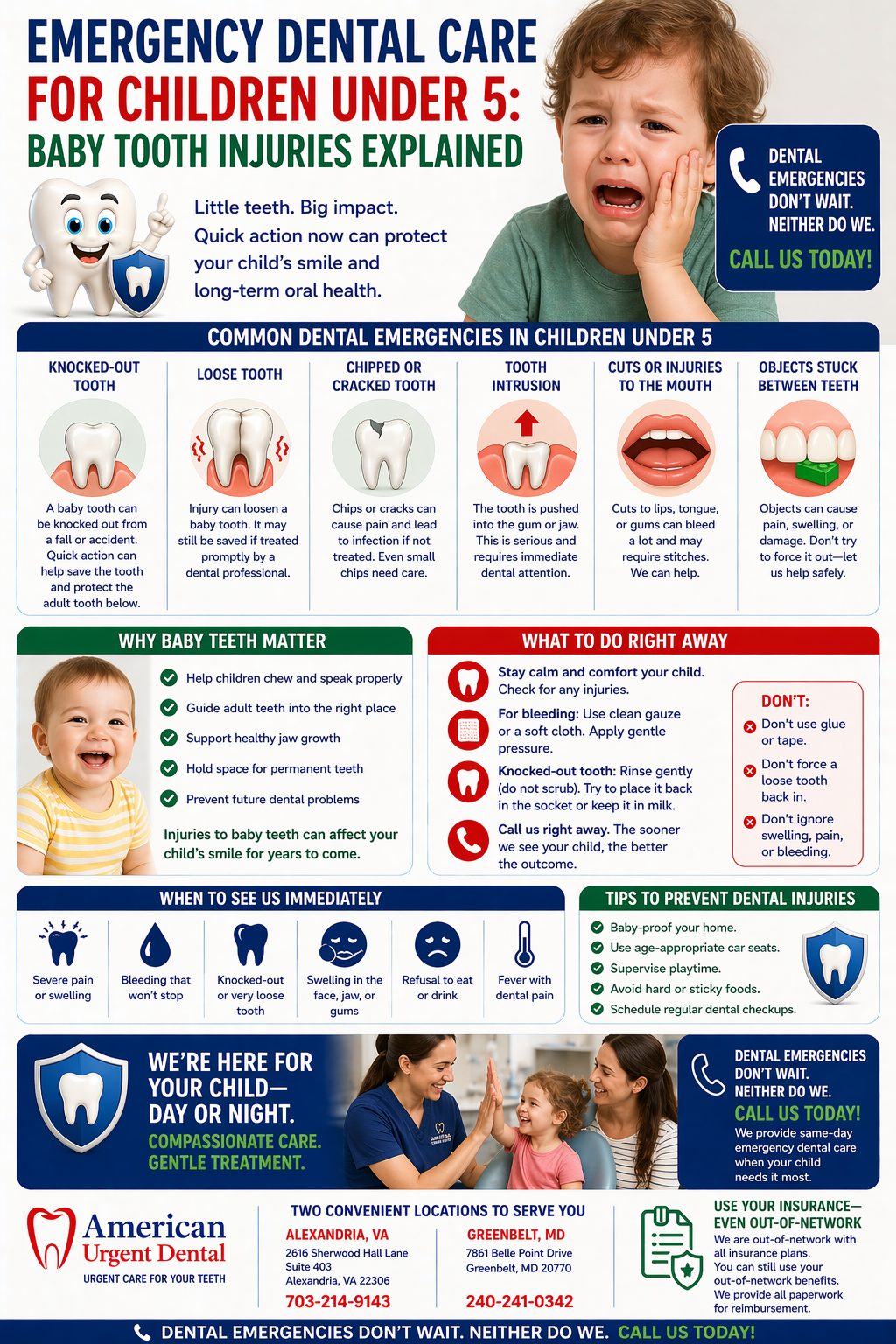
Emergency Dental Care for Children Under 5: Baby Tooth Injuries Explained
Baby tooth injuries in young children are common and alarming. American Urgent Dental in Alexandria, VA and Greenbelt, MD explains what's urgent, what to do, and how we care for your youngest patients.
When Your Toddler Falls and Hurts Their Tooth: A Parent's Guide
Toddlers fall. It's practically their full-time job between ages 1 and 3. They fall off playground equipment, tumble down stairs, run into furniture, and collide with other toddlers at breathtaking frequency. Many of these falls result in no injury at all. But some result in dental injuries — and when a small child is crying, their face is bleeding, and a tooth looks wrong, even the calmest parent can feel panic rising.
This guide is specifically for parents of children under 5 — whose dental injuries are dominated by baby tooth injuries with their own unique management principles. Understanding these principles helps you make faster, calmer, and better decisions in the stressful moments after a toddler tooth injury.
Baby Tooth Injury Philosophy: Protecting What's Underneath
The single most important concept governing baby tooth injury management is this: everything we do (and don't do) for an injured baby tooth is primarily aimed at protecting the developing permanent tooth directly beneath it in the jawbone.
The permanent upper front teeth — the ones that will eventually replace the baby front teeth — are developing in the jawbone directly behind and above the baby teeth, approximately at the level of the nose. Trauma to a baby tooth can reach the developing permanent tooth through the bone, potentially causing:
- Discoloration of the permanent tooth (white or yellow-brown spots from enamel damage)
- Dilaceration (a bend or deformity in the root of the permanent tooth from trauma during development)
- Delayed eruption or failure of the permanent tooth to erupt
- In severe cases, complete failure of the permanent tooth to develop normally
This is why baby tooth injuries are not 'just' about the baby tooth — they can have consequences that affect the permanent dentition for a lifetime if managed incorrectly.
The Most Common Baby Tooth Injuries by Type
Concussion and Subluxation (Tooth Sore to Touch But in Normal Position)
The tooth received a blow but hasn't moved from its normal position. It may be sore when touched, bleeding slightly at the gumline, and tender to gentle pressure. This is the mildest category of baby tooth injury. Treatment: soft diet for a week, gentle oral hygiene around the tooth, monitoring. The tooth is expected to recover fully. However, see us for an evaluation — an X-ray helps confirm the tooth hasn't moved in ways not visible clinically.
Luxated Baby Tooth (Tooth Moved From Its Position)
This is very common in toddlers. The tooth appears tilted, angled forward or backward, pushed sideways, or has moved up or down relative to neighboring teeth. Unlike permanent tooth luxations, baby tooth management is much more conservative:
- If the tooth has moved but is not blocking the bite and is not at immediate risk of damaging the underlying permanent tooth: may be left alone to spontaneously reposition over 1–2 months in some cases
- If the tooth is severely displaced, is blocking the bite, or radiographs suggest proximity to the developing permanent tooth: extraction may be the safest option
- The decision is made by a dentist with X-ray guidance — call us same day
Intruded Baby Tooth (Tooth Pushed Up Into the Gum)
One of the most alarming presentations for parents — the baby tooth appears to have partially or completely 'disappeared' into the gum after the child fell. The gum may be bleeding around the tooth socket. Depending on the direction the tooth was pushed, it may be pointing toward or away from the developing permanent tooth underneath.
This is a same-day evaluation emergency because of the potential proximity to the developing permanent tooth. In many cases (tooth pushed away from the permanent tooth), the tooth is monitored for spontaneous re-eruption, which often occurs over several months in young children. In other cases, extraction is appropriate.
Avulsed Baby Tooth (Tooth Completely Knocked Out)
The most important thing to know: Do NOT reimplant an avulsed baby tooth. This is the opposite of what you do for a knocked-out permanent tooth. Reimplanting a baby tooth risks pushing it into the developing permanent tooth below it in the bone.
Instead:
- Save the tooth if you can find it (to verify it's the whole tooth and no fragment remains in the socket)
- Control bleeding with gentle gauze pressure
- Check the gum for any remaining tooth fragments
- Call us for same-day evaluation
- We will X-ray to confirm no root fragment remains and to assess the underlying permanent tooth's condition
A missing baby front tooth is cosmetically concerning but functionally manageable. We can discuss space maintainers and other options to prevent space loss before the permanent tooth erupts if the tooth loss is significant.
Warning Signs After a Baby Tooth Injury That Require Prompt Follow-Up
In the days and weeks after a baby tooth injury, watch for:
- Tooth turning gray or dark: Indicates the pulp of the baby tooth has died. The tooth may need monitoring or extraction to prevent infection affecting the permanent tooth.
- A pimple or bump on the gum above the injured tooth: A dental fistula indicating infection/abscess. Requires same-day evaluation.
- Swelling or pus around the tooth: Sign of infection. Requires prompt dental care.
- Child consistently refusing to eat on that side: May indicate lingering pain or infection.
- Fever: Combined with any dental injury, requires prompt evaluation to rule out dental infection as the cause.
Comforting a Young Child After a Dental Injury
Young children take emotional cues from their parents. If you stay calm, speak in a reassuring tone, and treat the dental injury as something that can be fixed (because it usually can), your child will typically calm down significantly faster. Avoid language that signals panic or catastrophe. 'Your tooth got bumped. We're going to the dentist who is going to make sure everything is okay' is both accurate and reassuring.
Our team at American Urgent Dental has extensive experience working with young children, including toddlers in distress. We use age-appropriate communication, gentle technique, and patience to make the appointment as calm and comfortable as possible for your child and for you. Please call us when your child has a dental injury — we are here to help.
Get Same-Day Emergency Dental Care
American Urgent Dental — two convenient locations serving Northern Virginia and the Greater DC Metro area.
Alexandria, VA: 2616 Sherwood Hall Lane Ste 403, Alexandria, VA 22306 | 703-214-9143 (alexandria@americanurgentdental.com)
Greenbelt, MD: 7861 Belle Point Drive, Greenbelt, MD 20770 | 240-241-0342 (greenbelt@americanurgentdental.com)
📧 contact@americanurgentdental.com | 🌐 www.americanurgentdental.com
Don’t wait out the pain.
Same-day emergency care in Alexandria, VA & Greenbelt, MD — open weekends.